In the era of the "hustle" and digital nomadism, there is a seductive myth circulating online: the idea that you can start a business with absolutely nothing.
We hear stories of entrepreneurs launching empires from their college dorm rooms using just a laptop and free Wi-Fi. It sounds liberating. It makes business seem accessible to everyone (which, in many ways, it is).
But economically speaking, the idea that you can create value without inputs is impossible. It’s like trying to bake a cake without flour, eggs, heat, or a baker.
Every single business on earth from a lemonade stand to Google, and from a freelance graphic designer to a massive car factory relies on the same fundamental economic building blocks. These are known as the Four Factors of Production.
If you are missing even one, you don't have a business; you have an idea floating in a vacuum.
Let’s break down what these factors really mean in the modern world, and then look at a real-world example to see them in action.
The Four Ingredients of Every Business
Economics textbooks can make these concepts sound dry, but they are actually very practical. They are the DNA of your company.
1. Land (Natural Resources & Space)
When economists say "Land," they don't just mean dirt or farmland. They mean all natural resources that exist without human intervention.
What it includes: The physical ground a business occupies, water, minerals, oil, timber, and energy sources like wind or solar.
The modern twist: Even an online business uses "Land." Your home office takes up physical space. The data centers hosting your website sit on land and consume massive amounts of water and electricity (natural resources) to keep the servers cool and running.
2. Labor (Human Effort)
Labor is the human input into the production process. It is the mental and physical exertion applied to create a good or service.
What it includes: The physical work of assembling a product, the mental work of coding software, customer service interactions, and sales calls.
The modern twist: The biggest mistake solopreneurs make is thinking they have zero labor costs just because they don't have employees. You are the labor. Your time, energy, and expertise are finite resources that you are pouring into the business instead of selling to an employer for a salary.
3. Capital (The Tools, Not Just the Money)
This is the most frequently misunderstood factor. In regular conversation, "capital" usually means money. In economics, "Financial Capital" (money) is just what you use to buy real "Physical Capital."
What Physical Capital is: These are the man-made tools, machinery, buildings, and technology used to produce other goods and services. They are goods that don't get used up immediately (like raw materials do) but are used to do the work.
Examples: A carpenter's saw, a writer's laptop, a delivery truck, software licenses, and factory robots are all capital.
4. Entrepreneurship (The Spark)
You can have land, people, and tools, but nothing happens until someone combines them. Entrepreneurship is the human resource that organizes the other three factors.
What it includes: The vision to see an opportunity, the ability to create a strategy, and, crucially, the willingness to take on risk. The entrepreneur takes the initiative to combine resources in a new way to make a profit.
Putting It All Together: The Car Wash & Tyre Repair Shop
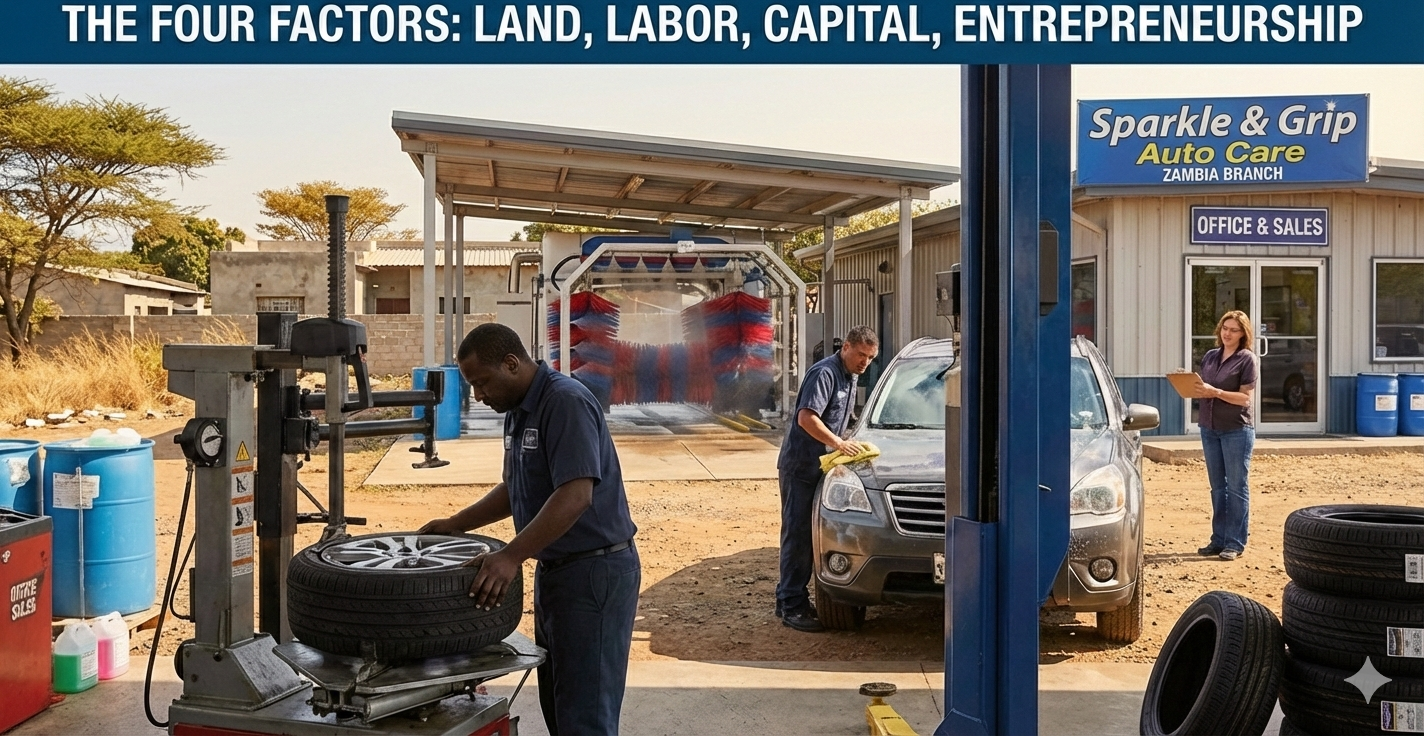
To prove that these factors are universal, let's step away from the digital world and look at a brick-and-mortar business where these inputs are highly visible: "Sparkle & Grip Auto Care," a combination car wash and tyre repair center.
You cannot run this business if you remove any single one of the four factors.
Here is how they manifest in this specific business model:
1. The "Land" at Sparkle & Grip
You cannot wash cars or change tyres in mid-air.
Physical Location: The business needs a substantial plot of land, preferably on a busy road with good visibility to build the wash bays and the garage structure, and to provide space for customers to line up.
Natural Resources: The car wash component is extremely dependent on natural resources, specifically massive quantities of water to clean the vehicles, and energy (electricity or gas) to heat that water and power the dryers.
2. The "Labor" at Sparkle & Grip
Even with automated machines, this business is service-heavy and relies on human effort.
Skilled Labor: You need experienced mechanics who know how to safely jack up a car, balance a tyre on a machine, and patch a puncture.
Unskilled/Semi-skilled Labor: People are needed to pre-wash the cars with handheld sprayers, dry the cars off at the end of the line, wipe down interiors, and manage the cash register.
3. The "Capital" at Sparkle & Grip
Remember, this refers to the tools used to provide the service. This business requires heavy capital investment.
For the Car Wash: The building structure itself, conveyor belt systems, automated giant brushes, high-pressure spray nozzles, water recycling systems, and industrial vacuums.
For Tyre Repair: Hydraulic car lifts (jacks), tyre changing machines (to pull the rubber off the metal rim), electronic wheel balancers, air compressors, and impact wrenches.
(Note: The soap and new tyres they sell are inventory/raw materials, not capital goods, as they get used up or sold off once).
4. The "Entrepreneurship" at Sparkle & Grip
Who made this happen?
This is the founder who recognized that the neighborhood had too many dirty cars and lots of potholes, creating a demand for both services under one roof.
They took the risk of signing a 10-year lease on the land. They secured a loan (financial capital) to buy the expensive machinery (physical capital) before having a single customer. They hired the staff and set the prices. Without their initiative, the land would just be an empty lot.
The Takeaway
The difference between a massive corporation and a "zero-dollar" startup isn't if they use the four factors of production, but how much of each they use and who owns them.
You might already own your "Land" (your apartment) and your "Capital" (your laptop), and you might be supplying all the "Labor" yourself for free. Because you don't see cash leaving your bank account for these things, it feels like they don't exist.
But they do. To build a viable business, you must respect these ingredients. You need to manage your own labor efficiently, maintain your capital tools effectively, and optimize the space you work in.
You can bake a small cake or a big cake, but you can't bake one without ingredients.
Discussion
Thank tukakula for your support.
Please Login to comment.